Éponine Thénardier
Les MisérablesÉponine Thénardier is the eldest of the Thénardier daughters, a young woman whose return to Marius Pontmercy brings him news he wants and reveals a private attachment she has not voiced before. The novel presents her in a stark double image: increasingly destitute, yet still beautiful. At the end of her life, she asks Marius for a promise that can only be fulfilled after her death, then tells him she had been a little in love with him. Her brief confession gives their encounter the shape of a farewell as well as a crucial exchange of information.
Identity and Reappearance
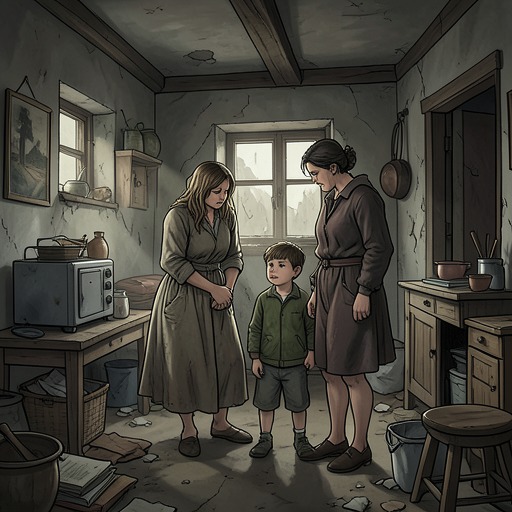
Marius recognizes Éponine as the unfortunate girl who had come to his room one morning, and now knows her name. She is identified as the eldest of the Thénardier daughters. Recognition links this street encounter to her earlier visit, while the interval between them is registered in her changed appearance: the same worn clothes have grown still more ragged, their holes wider and their fabric dirtier. The description makes deprivation visible as something that accumulates, not a condition that remains still.
The account holds poverty and beauty together rather than allowing one to cancel the other. Éponine has moved, paradoxically, toward both greater distress and greater radiance. Her bare feet, rags, hoarse voice, and sun-darkened, furrowed brow preserve the signs of hardship; her gaze remains at once free, bewildered, and unsteady. The account adds a frightened and lamentable quality to her face, associating it with the prison she has passed through and the misery surrounding her. Straw and hay tangled in her hair are explained not as a sign of madness but as evidence that she has slept in a stable loft. The correction matters: the dishevelment belongs to material hardship, not a fanciful likeness to Ophelia.
News and Connection to Marius
Éponine approaches Marius with a piece of news: she has the address. Its effect is immediate. Marius turns pale, and all his blood seems to rush to his heart; he asks which address. The exchange makes plain that the information has urgent value to him. Éponine, so far described through the visible signs of her own deprivation, now becomes the person who can give Marius access to what he seeks. Her role in the encounter is therefore active as well as emotional: she brings knowledge that matters to him, and her brief announcement changes the tenor of the scene.
The narrative places this practical service beside the contrast between Marius's need and Éponine's circumstances. She appears in the street barefoot and in worsening rags, carrying the marks of hardship and imprisonment; nevertheless, she is the one who arrives with the news he needs. Nothing in the scene turns her suffering into a simple explanation of her action. Instead, the sequence lets the disparity stand: her poverty is insistently described, while her information makes her consequential in Marius's pursuit.
Final Request and Confession
Near death, Éponine asks Marius to promise that he will kiss her on the forehead when she is dead, adding that she will feel it. Marius promises. She lets her head fall onto his knees and closes her eyes; he believes that her life has ended. The stillness is not quite the end: she slowly opens her eyes again, now marked by the darkness of death, and speaks once more. She tells Marius that she thinks she had been a little in love with him.
The confession is restrained and belated. Éponine does not claim a grand or returned love; she describes her feeling tentatively, as something she thinks she had felt. Its placement, after the request for a kiss and after Marius has already promised it, makes the scene a sequence of intimacies that arrive at the edge of death: first the promise, then the disclosure. She tries once more to smile and dies. The sequence preserves both gestures—the attempted smile and the fulfilled emotional closeness of resting against Marius—without suggesting that her confession changes his feelings.
Narrative Significance
Éponine's reappearance is composed around a reversal of visibility and agency. Her clothes and body record how far her material condition has deteriorated, yet she is not reduced to a spectacle of misery: she returns with information, directs Marius's attention to what she knows, and speaks plainly at the end. The description of her beauty beside her rags sharpens rather than resolves that tension. The scene insists on the distance between the striking young woman Marius sees and the hardship that has shaped her visible condition.
Her death closes the encounter at the moment when she names her attachment. The request that Marius kiss her forehead after she is gone gives physical form to a closeness she cannot claim in life; his promise answers that request, but the story offers no evidence that it makes their love mutual. Her final words remain modest, and her last attempt to smile is followed immediately by her death. In this compressed ending, practical help, unreturned affection, and the need for tenderness converge: Éponine gives Marius news, receives a promise, reveals what she feels, and dies before any further conversation is possible.